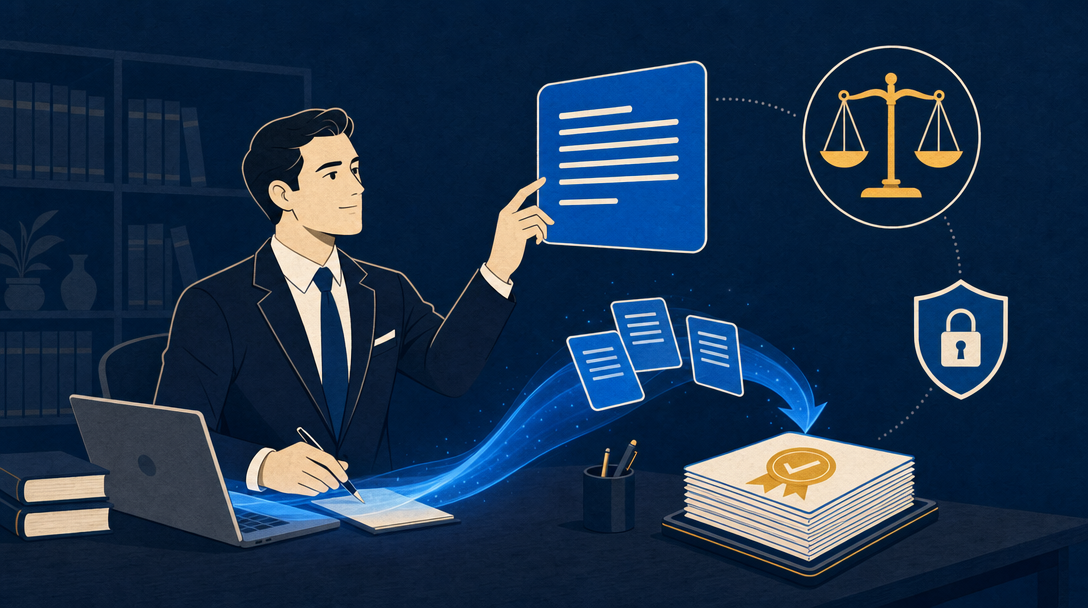
Most law firms do not have a Copilot licensing problem. They have a Copilot adoption problem. The seats are bought, the pilot ran, a few partners are impressed, and then it stalls. Associates are unsure what is allowed, nobody trusts it with client matter, and the firm-wide rollout that was supposed to follow never quite happens. The gap between owning Microsoft 365 Copilot and getting value from it is the real work, and for a law firm that work has an ethics dimension no generic training covers.
This page is about closing that gap: what Copilot actually does in legal practice, the confidentiality and competence obligations that shape how a firm deploys it, and the private training we deliver to move a firm from pilot to adoption.
Updated June 2026. Industry figures are sourced inline.
Why Microsoft Copilot rollouts stall in law firms
The demand backdrop is not subtle. In its fiscal-2026 third quarter, Microsoft 365 Copilot passed 20 million paid enterprise seats, with seat additions up 250% year over year. But buying has outrun using: independent survey work from Recon Analytics (more than 150,000 respondents) puts the workplace Copilot conversion rate, people with a seat who actually use it, at about 36%. The license is the easy part.
The legal sector shows the pattern in sharp relief. The International Legal Technology Association, the legal-technology member body, runs Copilot-focused programming for firms, which is association-scale evidence that firms are wrestling with adoption, not acquisition. And at the top of the market, Mayer Brown launched a firm-wide GenAI curriculum in April 2026, rolling out to its nearly 1,800 lawyers globally with mandatory core training. The firms that lead are treating AI skills as a training program, not a software purchase.
What Microsoft Copilot does in a law firm
Microsoft 365 Copilot is the paid per-seat assistant inside the tools a firm already runs, Outlook, Word, Teams, and SharePoint (licensing on Microsoft Learn). It is not the free consumer Copilot or public web chat: only the licensed version runs inside your tenant and honors your permissions, which is why client matter should never go near the free tools.
Each item below is a first-draft accelerator a lawyer reviews, not autonomous output, and quality varies with how well the firm’s content is organized. The legal value sits in the document- and communication-heavy work that fills a practice:
- Document drafting and review. First-draft a client letter, an internal memo, or a routine clause from your own precedents in Word, then refine; summarize a long document into its key points for a partner.
- Email and intake triage. Summarize a sprawling client thread into what was asked, what was promised, and what is outstanding, and draft the reply for a lawyer’s review.
- Meetings and matter notes. Recap a recorded client or internal call in Teams, pull action items, and turn them into a follow-up note.
- Knowledge retrieval. Find the right precedent, prior memo, or matter document across the firm’s SharePoint without hunting through folders.
None of this is the practice of law. It is the drafting, summarizing, and searching around the practice of law, which is exactly where lawyers lose billable hours. The judgment, the legal analysis, and the sign-off stay with the lawyer, every time.
The part generic training skips: ethics and confidentiality
A law firm cannot deploy Copilot the way a marketing team can, and this is where firm-specific training earns its place. One distinction frames all of it: Copilot only surfaces data a user already has at least view permission to, mirroring your existing access model (the product layer), but whether that access model is safe is the firm’s to own (the deployment layer).
- Confidentiality is non-negotiable. Loose or over-shared SharePoint permissions flow straight into Copilot, so a permissions and oversharing audit is a precondition before it touches matter data, alongside clear rules on what a lawyer should never paste into a prompt.
- Competence is now a documented duty. The ABA’s Model Rule 1.1, Comment 8 makes keeping abreast of “the benefits and risks associated with relevant technology” part of the duty of competence, and it has been adopted in 40-plus states. Some go further with hard hours: the Florida Bar requires at least 3 of the 30 CLE hours every three years in approved technology programs. Either way, knowing how AI tools work is increasingly part of competence, not optional, wherever your firm practices.
- Verification is a professional obligation. Microsoft itself states that Copilot’s responses “aren’t guaranteed to be 100% factual” and should be reviewed before use, and courts have already sanctioned lawyers over AI-fabricated citations in filings. Firm training has to teach the verification discipline, not just the prompt.
A note on what we are and are not: this is practical deployment and skills training, not a CLE-credit course. Citizen Development Academy is not a CLE provider; if your lawyers need the technology-CLE hours themselves, those come from accredited CLE sources. What we provide is the hands-on capability to actually use the tools your firm already pays for, safely. The full scope and boundary list is below.
From pilot to adoption: how the engagement works
The training is private to your firm and built around legal workflows, not generic demos. The shape, scaled to firm size:
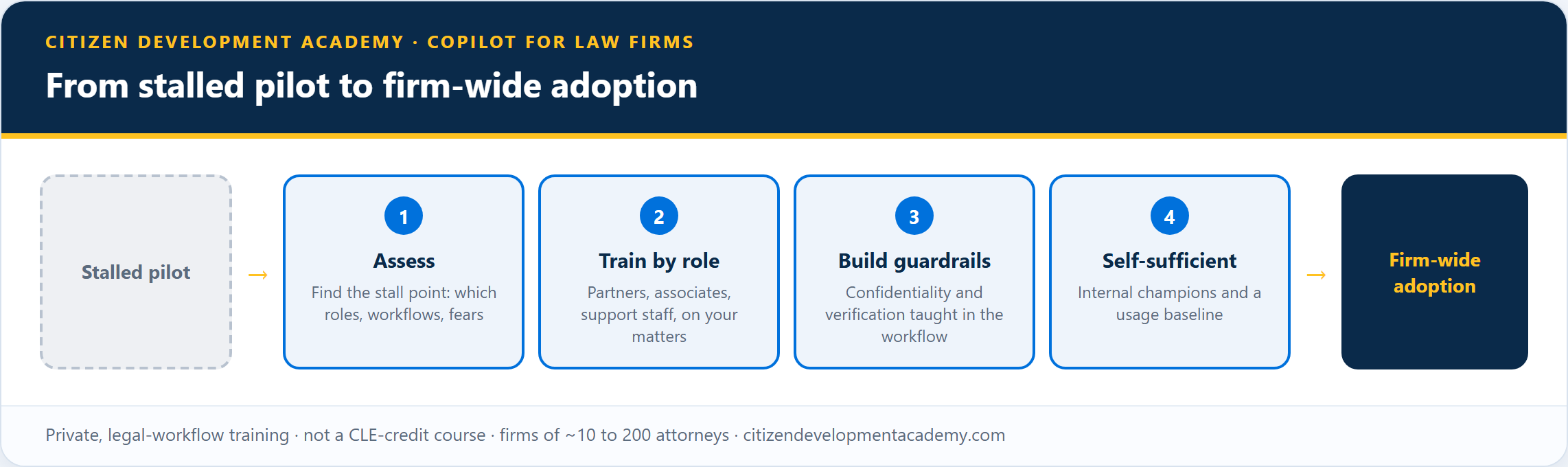
- Assess where it stalled. Most firms have a pilot and a stall point: which roles, which workflows, which fear. We start there.
- Train by role. Partners, associates, and legal-support staff use Copilot differently; the sessions match the work each actually does, with your matter types as the examples.
- Build the guardrails into the training. The confidentiality and verification rules above are taught as part of the workflow, so adoption and compliance arrive together rather than fighting each other.
- Leave the firm self-sufficient. Internal champions and a usage baseline, so the rollout continues after we leave.
This is a conversation, not a checkout. Firms of roughly 10 to 200 attorneys are the sweet spot; tell us the firm size and where the rollout is stuck. The same private-cohort model runs for non-legal teams too: see Power Platform training for corporate teams, or the role-specific pages for accountants and executive assistants.
Discuss training for your firm
What this engagement does not include
To set expectations plainly, the training is not:
- A CLE-credit course; Citizen Development Academy is not a CLE provider, and technology-CLE hours come from accredited sources.
- Microsoft-endorsed or reviewed, and not a legal-specialist accreditation; the Learning Partner status governs courseware and trainer standards only.
- The practice of law: legal judgment, analysis, and sign-off stay with the lawyer.
- A fix for loose SharePoint permissions; that access-governance audit is the firm’s to run (we flag it and advise).
- Tenant or security implementation; when an engagement needs that, we say so and help scope it.
Built by a Microsoft Learning Partner

Citizen Development Academy is a Microsoft Learning Partner: our training uses official Microsoft courseware where Microsoft publishes it and our own field-built material where it does not, delivered by Microsoft Certified Trainers. Partner status governs those standards; it does not mean Microsoft endorses or reviews this training, and it is not a statement of legal-specialist or CLE accreditation.
FAQ
Is Microsoft Copilot safe for confidential client data?
It can be, but safety is a deployment outcome, not a default. Microsoft 365 Copilot operates within your existing Microsoft 365 permissions, and Microsoft states that your prompts, responses, and Microsoft Graph data are not used to train its foundation models. Whether it is actually safe depends on how tightly your firm’s access and SharePoint permissions are configured and on lawyers knowing what not to paste. That governance and discipline is exactly what firm training covers.
Does this training count for CLE credit?
No. This is practical deployment and skills training; Citizen Development Academy is not a CLE provider. Technology-CLE hours, where your state requires them, come from accredited CLE sources. The two are complementary: we teach the tool, CLE certifies the hours.
We bought Copilot seats and barely anyone uses them. Is that normal?
Yes, and it is the core problem this addresses. Industry conversion data shows roughly a third of seat-holders actually adopt Copilot; the rest stall on uncertainty about what is allowed and how to use it well. Role-based training built around your matters is what moves the number.
What size firm is this for?
Best fit is firms of roughly 10 to 200 attorneys. Larger firms tend to build internal curricula (as Mayer Brown did); smaller practices may be served by our open courses. Ask and we will tell you honestly which fits.
Do you implement or just train?
Our focus is training and adoption, including the access-governance conversation. When an engagement needs hands-on tenant or security implementation, we will say so and help you scope what to bring in.